Description
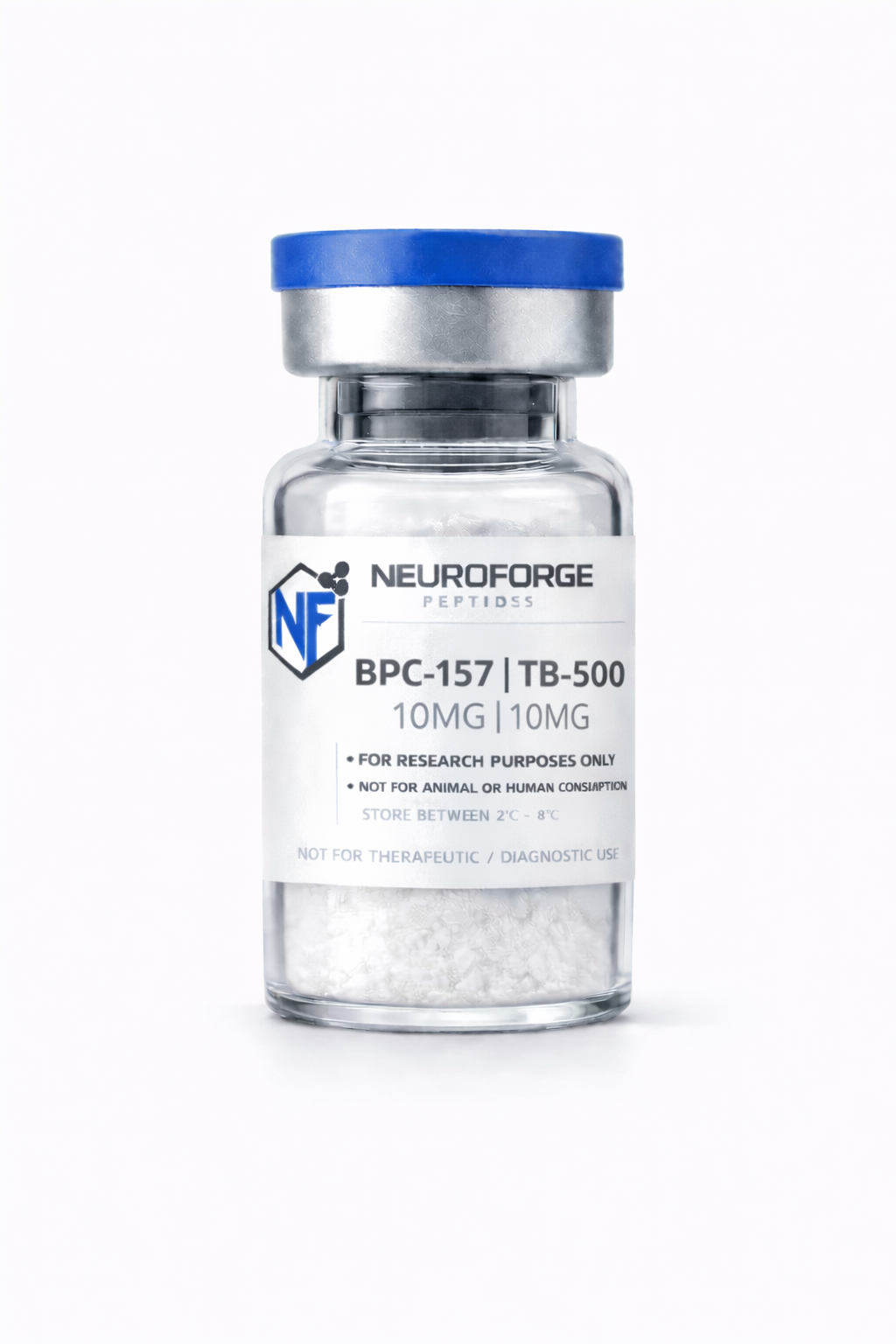
BPC-157 | TB-500 (10MG / 10MG) — “WOLVERINE STACK” Dual Peptide Research Blend
Comprehensive Scientific Overview
The BPC-157 | TB-500 “Wolverine Stack” combines two extensively studied regenerative research peptides into a single dual-pathway formulation designed for advanced tissue repair, angiogenesis, and recovery pathway investigations.
BPC-157 is a synthetic pentadecapeptide derived from a protective gastric protein fragment and has been widely studied for its role in cytoprotection, angiogenic signaling, and soft-tissue repair mechanisms. TB-500 (Thymosin Beta-4 fragment) is a synthetic analog of a naturally occurring actin-binding peptide involved in cell migration, tissue remodeling, and wound healing pathways.
When studied together, these peptides allow researchers to explore complementary regenerative mechanisms across multiple tissue systems, making the Wolverine Stack a valuable tool in controlled laboratory environments.
At NeuroForge Peptides, this blend is supplied at ≥98% purity in lyophilized form and analytically verified via HPLC and mass spectrometry to support consistency and reliability in research settings. This material is intended strictly for in vitro and animal research and is not for human or veterinary use.
Mechanism of Action
The Wolverine Stack operates through complementary regenerative pathways:
• Angiogenic signaling support (BPC-157) — Associated with VEGF pathway modulation and microvascular repair (Sikiric et al.)
• Actin regulation and cell migration (TB-500) — Facilitates cytoskeletal remodeling and cellular movement (Goldstein et al.)
• Nitric oxide pathway interaction — BPC-157 research suggests involvement in NO system regulation
• Stem cell recruitment signaling — TB-500 has been studied for effects on progenitor cell mobilization
• Extracellular matrix remodeling — Dual peptide activity supports tissue repair modeling
Key Research Applications
1. Soft Tissue & Musculoskeletal Research
The Wolverine Stack is widely studied in models of connective tissue repair.
Common research endpoints
-
Tendon and ligament repair signaling
-
Muscle recovery pathways
-
Collagen organization
-
Fibroblast migration
Preclinical studies suggest complementary activity between gastric peptide signaling (BPC-157) and actin-mediated repair pathways (TB-500).
2. Angiogenesis & Vascular Research
Both peptides have been investigated for roles in microvascular biology.
Research observations include:
-
Enhanced capillary formation
-
VEGF pathway involvement
-
Improved blood flow signaling
-
Endothelial cell migration
These properties make the stack useful for ischemia and wound-healing models.
3. Wound Healing Models
The combination is frequently evaluated in dermal and epithelial repair studies.
Typical research focuses:
-
Accelerated wound closure dynamics
-
Keratinocyte migration
-
Granulation tissue formation
-
Scar modulation pathways
4. Gastrointestinal & Organ Protection Research (BPC-157 Focus)
BPC-157 has been studied in models involving:
-
Gastric mucosal integrity
-
Intestinal healing pathways
-
Cytoprotective signaling
-
Inflammatory modulation
5. Cellular Migration & Regenerative Signaling (TB-500 Focus)
TB-500 research commonly investigates:
-
Actin polymerization
-
Cell motility
-
Tissue remodeling
-
Developmental repair pathways
Research Usage Guidelines
For laboratory research only. Not for human or veterinary use.
| Research Model | Typical Range | Route | Key Focus |
|---|---|---|---|
| In vitro | 1–100 nM | Cell media | Migration & repair |
| Rodent models | Variable | SC/IP | Tissue recovery |
| Wound models | Variable | Local/systemic | Healing dynamics |
Product Specifications
-
Blend: BPC-157 + TB-500
-
Quantity: 10 mg / 10 mg per vial
-
Purity: ≥98%
-
Form: Lyophilized powder in sterile glass vial
-
Class: Regenerative peptide blend
-
Storage: −20 °C recommended
Reconstitution & Handling
-
Solvent: Sterile bacteriostatic water
-
Lyophilized stability: 24 months at −20 °C
-
Reconstituted stability: Up to 30 days at 4 °C
-
Avoid repeated freeze–thaw cycles
-
Protect from light
Why Choose NeuroForge Peptides
✔ ≥98% HPLC-verified purity
✔ Dual regenerative pathway blend
✔ Lyophilized for stability
✔ Third-party testing available
✔ Fast, discreet U.S. shipping
Important Notice
Research Use Only: This product is sold exclusively for laboratory research purposes. It is not approved for human or veterinary use. Purchasers are responsible for compliance with all applicable regulations governing research materials.
References
Sikiric et al. — BPC-157 cytoprotective and angiogenic research
Goldstein et al. — Thymosin Beta-4 and tissue repair mechanisms
Hinkle et al. — Actin-binding peptide biology
Gwyer et al. — Thymosin Beta-4 in wound healing
Reviews
There are no reviews yet.