
Description
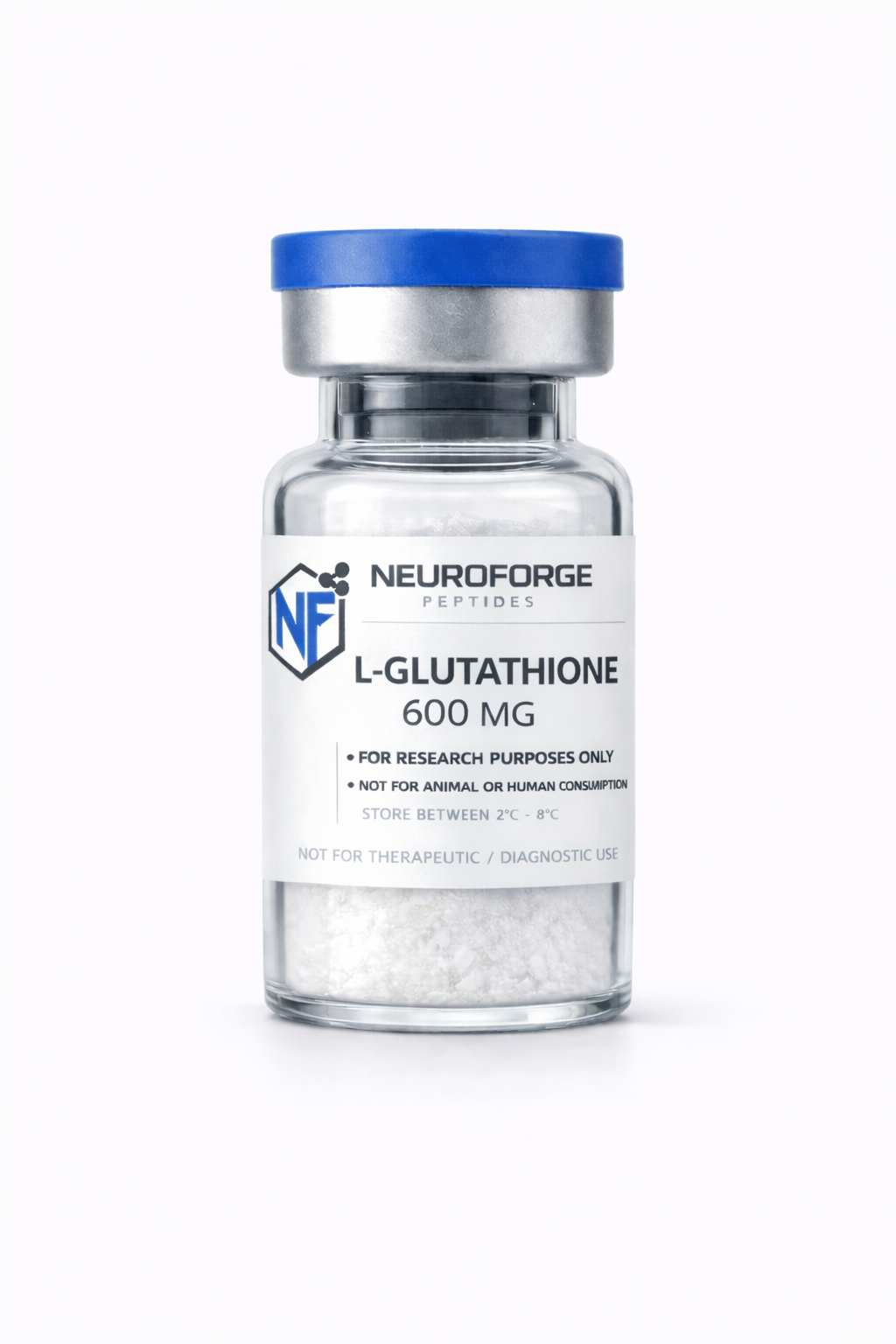
Glutathione – 600mg — Master Antioxidant for Cellular Redox and Detoxification Studies
Disclaimer
ATTENTION: NEUROFORGEPEPTIDES.COM PRODUCTS ARE INTENDED FOR LABORATORY RESEARCH AND IN-VITRO STUDIES ONLY. All information presented is for educational and scientific research purposes. These products are not for human or veterinary use, consumption, or diagnostic applications. They are not pharmaceuticals, food additives, or dietary supplements.
By purchasing from NeuroForge Peptides, you acknowledge that you are a qualified researcher operating in a controlled laboratory environment and agree to comply with all applicable local, state, and federal regulations governing research chemicals. Handle all materials using appropriate personal protective equipment (PPE) and established laboratory safety protocols.
The Master Cellular Protector: A Research Guide to Reduced L-Glutathione
Welcome, researchers, to NeuroForge Peptides’ technical overview of Reduced L-Glutathione (GSH), a cornerstone molecule in cellular defense systems. This product contains 600mg of high-purity lyophilized powder, providing substantial material for controlled in-vitro investigation.
Reduced L-Glutathione is a tripeptide (γ-L-glutamyl-L-cysteinylglycine) present in virtually all mammalian cells and is widely regarded as the “master antioxidant” due to its central role in maintaining redox homeostasis. Research applications span oxidative stress biology, detoxification pathways, mitochondrial function, and immunology.
This overview is intended as a foundational research primer to support experimental design.
Section 1: Scientific Basis of Glutathione Mechanism
The research value of glutathione lies in its multifunctional role within the cellular antioxidant network and its importance as a biomarker of oxidative stress.
Direct Free Radical Scavenging
The thiol (-SH) group within the cysteine residue acts as a potent reducing agent. It directly neutralizes reactive oxygen species (ROS), including:
-
Hydrogen peroxide (H₂O₂)
-
Superoxide anions (O₂⁻)
-
Hydroxyl radicals (•OH)
During this process, reduced glutathione (GSH) becomes oxidized to glutathione disulfide (GSSG), serving as a primary defense against oxidative damage to lipids, proteins, and DNA.
Cofactor for Antioxidant Enzymes
GSH functions as an essential electron donor for major antioxidant systems:
Glutathione Peroxidase (GPx)
Uses GSH to reduce lipid hydroperoxides and hydrogen peroxide to water, producing GSSG.
Glutaredoxin (Grx)
Utilizes GSH to reduce protein disulfides and regulate redox signaling pathways.
This enzymatic recycling significantly amplifies glutathione’s protective capacity beyond its molar concentration.
Cellular Detoxification (Phase II Conjugation)
In hepatic and extrahepatic tissues, glutathione S-transferase (GST) enzymes conjugate GSH to electrophilic xenobiotics, toxins, and carcinogens. This increases water solubility and facilitates cellular export.
This pathway remains a primary focus in toxicology and pharmacology research.
Regulation of Cellular Redox State
The intracellular GSH:GSSG ratio is a key indicator of cellular redox balance.
-
High ratio (>100:1): reducing, protective environment
-
Shift toward GSSG: oxidative stress signaling
Changes in this ratio can trigger adaptive responses or apoptotic pathways, making it a critical experimental endpoint.
Section 2: Key Research Applications
Our 600mg vial of Reduced L-Glutathione is designed for controlled in-vitro research.
2.1 Oxidative Stress and Cellular Resilience
Glutathione is widely used in models of aging, neurodegeneration, and chronic disease.
Relevant Study:
Meister, A., & Anderson, M. E. (1983). Glutathione. Annual Review of Biochemistry, 52, 711-760.
PubMed Link: https://pubmed.ncbi.nlm.nih.gov/6137189/
Application Study:
Dringen, R., & Hamprecht, B. (1997). Journal of Neurochemistry, 69(6), 2284-2295.
PubMed Link: https://pubmed.ncbi.nlm.nih.gov/9375655/
Research Implication
Researchers may use GSH to pre-treat or co-treat cell cultures exposed to pro-oxidants such as:
-
tert-butyl hydroperoxide (tBHP)
-
Hydrogen peroxide
-
Rotenone
Common endpoints include:
-
Cell viability (MTT / LDH)
-
Lipid peroxidation (MDA assay)
-
Protein carbonylation
-
Intracellular GSH/GSSG quantification
Estimated In-Vitro Usage
Typical effective concentrations: 0.1 mM to 5 mM
Example:
A 10 mL culture at 1 mM requires ~3.1 mg of GSH.
The 600mg vial supports extensive multi-experiment workflows.
2.2 Liver Detoxification and Toxicology
The liver is the primary site of glutathione-dependent detoxification.
Relevant Study:
Sies, H. (1999). Free Radical Biology and Medicine, 27(9-10), 916-921.
PubMed Link: https://pubmed.ncbi.nlm.nih.gov/10569624/
Classic Model
Acetaminophen (APAP) hepatotoxicity remains a standard model driven by glutathione depletion.
Research Implication
Use GSH in hepatocyte systems (e.g., HepG2) challenged with:
-
APAP
-
Ethanol
-
CCl₄
Measure:
-
ALT/AST release
-
Cellular GSH depletion
-
GST activity
-
Cell viability
Typical detoxification studies use 2–10 mM concentrations.
2.3 Immunomodulation and Inflammation Research
Intracellular glutathione levels strongly influence immune cell behavior.
Relevant Study:
Peterson, J. D., et al. (1998). PNAS, 95(6), 3071-3076.
PubMed Link: https://pubmed.ncbi.nlm.nih.gov/9501218/
Key Finding
Elevated glutathione in antigen-presenting cells promoted a Th2-biased response, while depletion favored Th1 signaling.
Research Implication
Applicable immune models include:
-
Macrophages (RAW 264.7)
-
T-cells
-
Dendritic cells
Measured outcomes:
-
Cytokine profiles (IL-1β, TNF-α, IL-10)
-
Phagocytic activity
-
Surface marker expression
Typical concentrations: 0.5–2 mM
Section 3: Synergistic Research Opportunities
With NAC (N-Acetylcysteine)
Compare direct GSH supplementation vs precursor-driven synthesis.
With Alpha-Lipoic Acid
ALA may regenerate GSSG back to GSH, supporting antioxidant network studies.
With Mitochondrial-Targeted Peptides (e.g., SS-31)
Evaluate combined cellular vs mitochondrial oxidative protection strategies.
Section 4: NeuroForge Peptides Quality Standards
Product Specifications
-
Compound: Reduced L-Glutathione (GSH)
-
Quantity: 600 mg per vial
-
Molecular Formula: C₁₀H₁₇N₃O₆S
-
Molecular Weight: 307.32 g/mol
-
Purity: ≥98% (HPLC verified)
-
Form: White lyophilized powder
-
Storage: −20 °C or below
-
Solubility: Water soluble (prepare fresh solutions)
Reviews
There are no reviews yet.