Description
PT-141 (Bremelanotide) — Research Peptide for CNS & Melanocortin Receptor Studies
Comprehensive Scientific Overview
PT-141 (Bremelanotide) is a synthetic heptapeptide derived from Melanotan II with selective activity at melanocortin receptors, particularly MC3R and MC4R. It has become an important research tool for investigating central nervous system signaling, neuroendocrine pathways, and behavioral modulation.
Unlike many peripheral peptides, PT-141 demonstrates efficient blood–brain barrier penetration, making it especially valuable for studying central melanocortin mechanisms and downstream physiological responses.
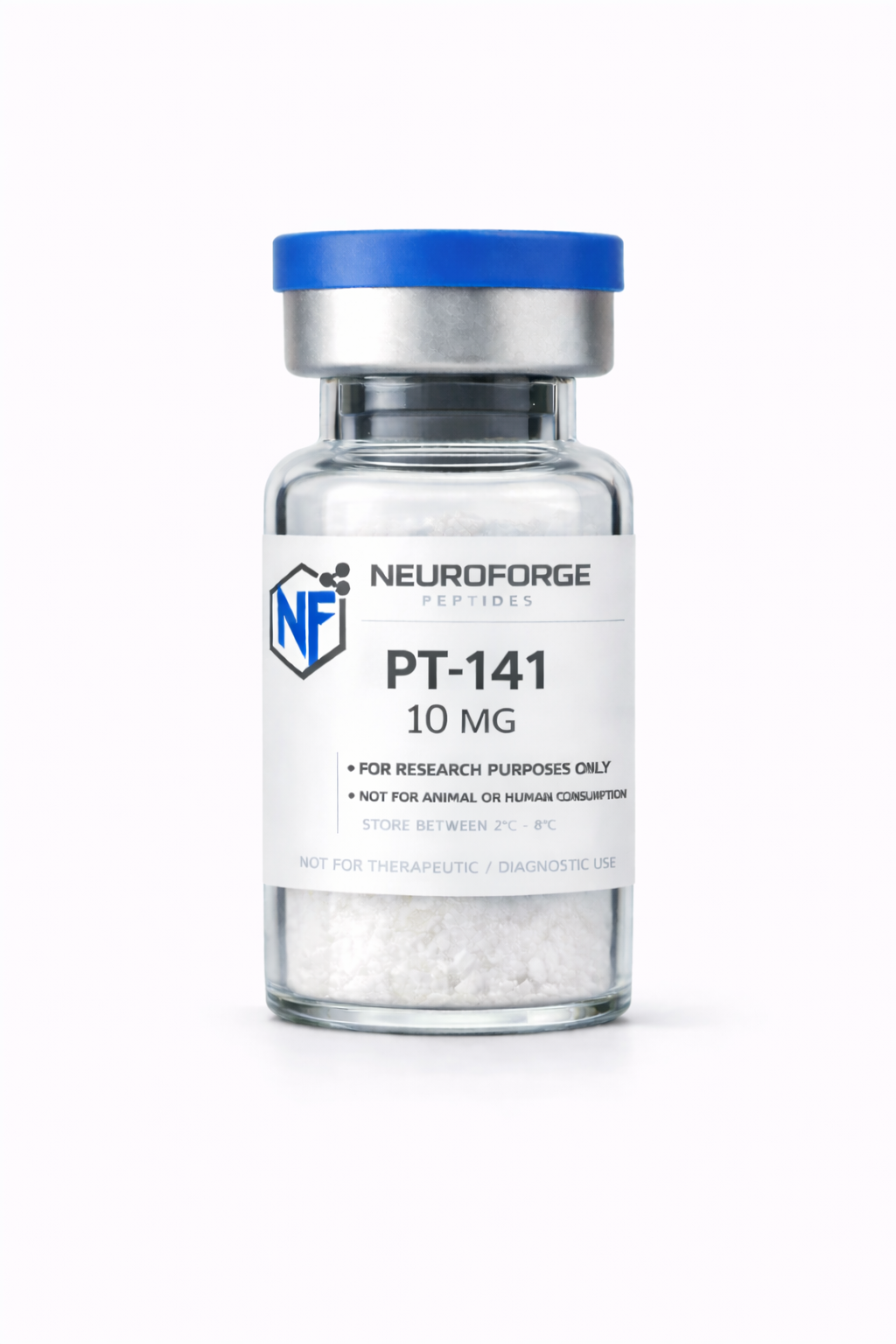
At NeuroForge Peptides, PT-141 is supplied at ≥98% purity in lyophilized form and analytically verified via HPLC and mass spectrometry to support consistency and stability in laboratory environments. This material is intended strictly for in vitro and animal research and is not for human or veterinary use.
Mechanism of Action
PT-141 interacts with melanocortin pathways through several well-characterized mechanisms:
-
Selective receptor activity — High affinity for MC4R with meaningful activity at MC3R and minimal interaction with MC1R, MC2R, and MC5R (Hadley, 2005)
-
Blood–brain barrier penetration — Efficient CNS access due to small molecular size and lipophilicity (King et al., 2007)
-
Dopaminergic modulation — Indirect influence on dopamine signaling within the nucleus accumbens (Martin et al., 2011)
-
Nitric oxide signaling — Activation of nitric oxide synthase in specific neural circuits (Rosen et al., 2013)
Key Research Applications
1. Central Nervous System Research
PT-141 has been widely studied in neuroendocrine and CNS activation models.
Neuroendocrine activation study
-
Protocol: 0.1–1.0 mg/kg subcutaneous (rodent models)
-
Findings: Dose-dependent hypothalamic activation with increased c-Fos expression (Vergoni et al., 2009)
-
Primary pathway: MC4R activation in CNS nuclei
BBB penetration study
-
Protocol: 0.5 mg/kg IV (primate models)
-
Findings: CNS penetration within 10–15 minutes with receptor engagement lasting 2–4 hours (King et al., 2007)
2. Behavioral Neuroscience Research
PT-141 has demonstrated activity in motivation and behavioral paradigms.
Motivation and reward signaling
-
Protocol: 0.25–2.0 mg/kg subcutaneous (rodents)
-
Findings: Increased motivated behavior and altered reward valuation (Martin et al., 2011)
Social behavior models
-
Protocol: 0.1–0.5 mg/kg administration
-
Findings: Modulation of social approach and hierarchy behaviors (Minakova et al., 2012)
3. Autonomic Nervous System Research
Emerging data suggest PT-141 influences autonomic regulation.
Cardiovascular signaling
-
Protocol: 0.5–2.0 mg/kg IV (canine models)
-
Findings: Dose-dependent increases in blood pressure and heart rate via central sympathetic activation (Van der Ploeg et al., 2002)
Thermoregulatory studies
-
Protocol: 0.1–1.0 mg/kg subcutaneous
-
Findings: Altered temperature regulation through hypothalamic MC4R pathways (Adan et al., 2006)
Research Usage Guidelines
For laboratory research only. Not for human or veterinary use.
| Research Model | Range | Route | Key Focus |
|---|---|---|---|
| In vitro | 1–100 µM | Cell media | Receptor signaling |
| Rodent models | 0.1–2.0 mg/kg | Subcutaneous | Behavioral & neural activity |
| Primate models | 0.05–0.5 mg/kg | SC / IV | CNS penetration |
| Receptor assays | 0.1–10 nM | Binding assays | Affinity & activation |
Reconstitution & Handling
-
Solvent: Sterile bacteriostatic water or saline
-
Lyophilized storage: Stable 24 months at −20 °C
-
Reconstituted solution: Stable up to 30 days at 4 °C
-
Light protection: Recommended during storage and handling
Preparation Notes
-
Reconstitute with appropriate sterile diluent
-
Gently swirl to dissolve (do not vortex)
-
Dilute to working concentration as needed
-
Store protected from light
Quality Assurance
NeuroForge Peptides maintains strict analytical standards:
-
≥98% purity verified by HPLC
-
Mass spectrometry sequence confirmation
-
Endotoxin level: <0.1 EU/mg
-
Sterility testing via membrane filtration
-
Batch-specific Certificate of Analysis available
Comparative Research Profile
Versus other melanocortin agonists
-
Preferential MC3R/MC4R activity
-
Strong CNS penetration
-
Favorable metabolic stability
-
Targeted melanocortin pathway engagement
Versus general behavioral compounds
-
Distinct melanocortin mechanism
-
Predictable dose-response profile
-
Multi-domain behavioral effects
-
Extensive published literature base
Research Considerations
-
Dose-dependent and potentially biphasic responses
-
Species-specific variability may occur
-
Circadian timing may influence outcomes
-
Behavioral effects may depend on baseline state
Available Research Formats
-
10 mg vial — lyophilized
-
25 mg vial — lyophilized
-
Bulk quantities available upon request
-
Custom synthesis support available
Important Notice
Intended Use: For qualified laboratory research only. Not for human or veterinary use.
Regulatory Compliance: Purchasers are responsible for compliance with all applicable regulations governing research materials.
Safety Handling: Appropriate PPE and laboratory protocols must be followed.
Liability: NeuroForge Peptides assumes no liability for misuse or improper handling.
Storage: Maintain lyophilized material at −20 °C protected from light. Use reconstituted solution within 30 days when refrigerated.
Research Ethics: Use only within properly approved research protocols.
Selected References
• Reduction in corpora lutea number in obese melanocortin-4-receptor-deficient mice. PubMed
• Evaluation of PT-141 safety and pharmacokinetics in healthy males and patients with inadequate response to Viagra. PubMed
• PT-141 induces penile erection via brain and spinal melanocortin receptors. PubMed
• Melanotan II enhances proceptive sexual behaviors in female rats. PubMed
• Bremelanotide as a salvage treatment for sildenafil failures. PubMed
• Anti-fungal and anti-inflammatory effects of melanocortin against Candida albicans. PubMed
• Skin cancer risks associated with MC1-R variants. PubMed
• Skin phototype and melanocortin receptor activity. PubMed
• Melanotan II and thermogenic capacity in mice. PubMed
• Bremelanotide’s effect on body weight in obese women. PubMed
Reviews
There are no reviews yet.